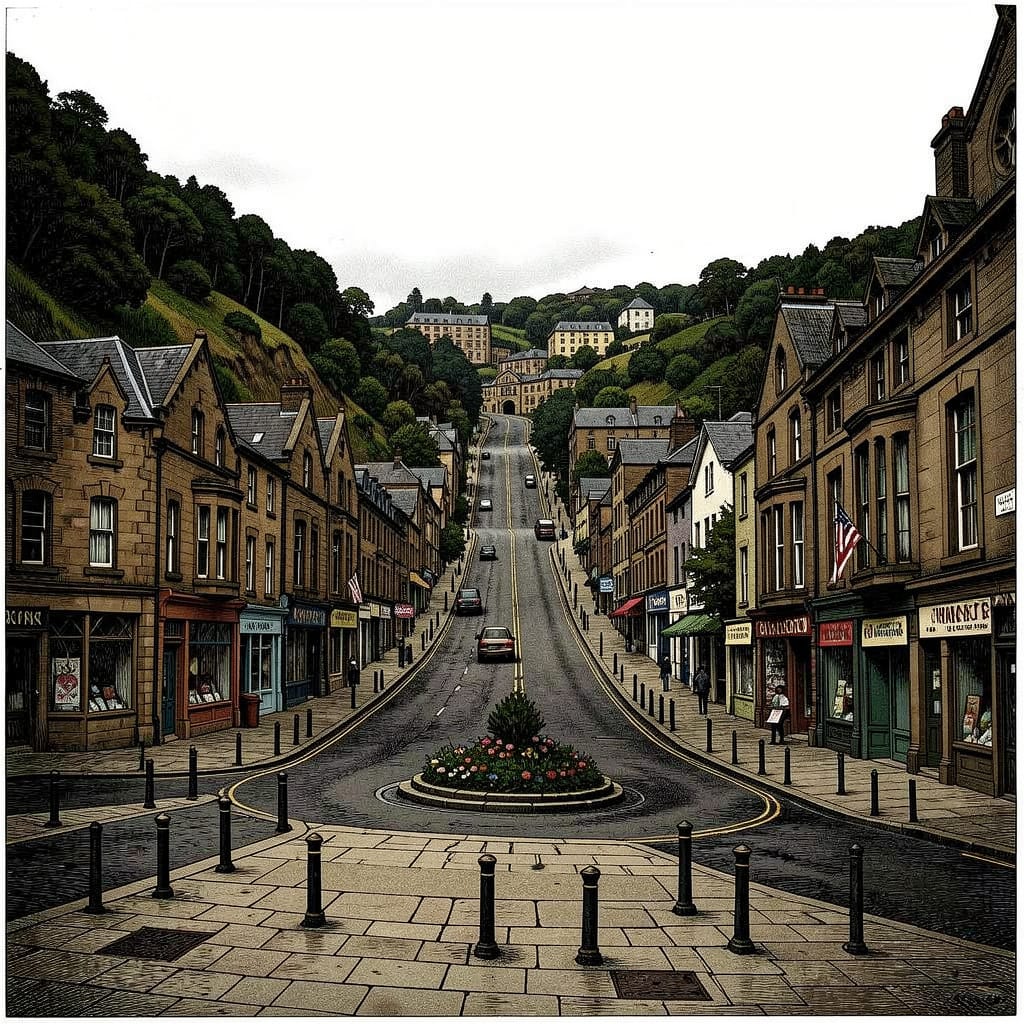
Matlock's recorded history begins in the Domesday survey of 1086, in which the parish is recorded as Meslach. The Old English origin is generally read as mæðlác — ‘the council oak’ or ‘the moot oak’ — a name preserving the memory of an Anglo-Saxon meeting-place beneath a particular tree, with the river crossing and the small farming settlement clustered nearby. The medieval and early modern settlement was a small upland farming village clustered around the church of St Giles on the higher ground above the gorge; the limestone cliffs and the river itself were a barrier to settlement rather than its focus, and the town centre of modern Matlock sits well above the valley floor.
The discovery of warm springs at Matlock Bath, in the gorge below, is conventionally dated to the late seventeenth century — though the springs themselves were known much earlier — and the first bath house at the springs was built in 1696. Through the eighteenth century, Matlock Bath developed into one of the principal English spa resorts, particularly favoured by the Romantic-era traveller. Romantic-era visitors, including Lord Byron, Mary Shelley and John Ruskin, paid visits, and the dramatic limestone gorge drew comparisons to the more famous spa towns of the European Alps — a miniature Switzerland, in the comparison the town has, ever since, found impossible to retire.
Matlock proper transformed in the mid-nineteenth century through the singular ambition of John Smedley (1803–1874). Smedley, a successful Lea Mills hosiery manufacturer, became persuaded after a personal illness in the early 1850s that hydropathy — the medical use of cold water applications — was a near-universal therapeutic system. In 1853 he opened Smedley's Hydro, an enormous Italianate hydropathic establishment on the slope above the town, which over the following two decades grew to accommodate several hundred residents and became the largest hydro in England. Smedley also built the eccentric private mansion of Riber Castle on the ridge above the town between 1862 and 1868, which remained the family residence until his death and subsequently passed through a series of uses, falling derelict for much of the twentieth century before recent partial restoration.
The Hydro continued to operate as a health resort into the twentieth century, with diminishing custom as the spa cure went out of medical fashion, before closing in 1955. In the same year, Derbyshire County Council relocated its administrative headquarters from Derby into the building, where they have remained ever since. Matlock has been the county town in name and in fact since that date, with Derby — since 1997 a unitary authority outside the county council's remit — retaining only ceremonial and historic associations with the county.
The town's economic life in the second half of the twentieth century has been concentrated in county government, tourism along the Matlock Bath gorge, and the continuing operation of the Lea Mills textile works at John Smedley Ltd, the knitwear company descended directly from the eighteenth-century cotton mill which the hydropathic Smedley inherited. The company, founded in 1784, still operates from its original mill site a few miles south-west of the town, and is among the oldest manufacturing concerns in continuous family ownership in the United Kingdom.
The two-mile stretch of the Derwent gorge between Matlock and the southern end of Matlock Bath is one of the most concentrated pieces of dramatic geology in lowland England. The river has cut its way through the Carboniferous limestone of the southern White Peak, exposing two-hundred-million-year-old reef beds in vertical cliffs on the eastern wall and producing the long wooded slope of the western side. High Tor, the principal eastern cliff, rises 120 metres above the river in a near-vertical face of pale limestone visible from the road, the railway and the riverside; it has been a recognised landmark and tourist destination since the late eighteenth century, with paths laid out across the summit and across the network of disused lead mines (the High Tor Grottoes) in the cliff face beneath.
The Heights of Abraham, on the western ridge above Matlock Bath, are named after the famous Heights of Abraham at Quebec, where General Wolfe defeated the French in 1759; the Derbyshire Heights were given the name in the late eighteenth century in conscious echo of the Canadian landscape. The two principal show caves on the ridge — the Great Masson Cavern and the Rutland Cavern — were originally lead mines worked from the medieval period onward, only converted to commercial show caves in the early nineteenth century. The Heights of Abraham cable car, suspended on a span of nearly half a mile across the gorge, was opened in March 1984; it was the first alpine-style cable car system installed at a British tourist attraction. The Matlock Bath illuminations, an autumn festival of riverside lights running for several weeks each year since the late nineteenth century, are the principal seasonal draw to the gorge.
The building known as Smedley's Hydro — now officially County Hall, the headquarters of Derbyshire County Council — is the largest and most architecturally distinctive structure in Matlock. Built between 1853 and 1885 in successive phases by John Smedley and his architectural collaborators, the building is a sprawling four-storey complex of Italianate frontages with a central tower and pyramidal roof, set in formal gardens on the slope above Matlock Bank. At the height of the Hydro's nineteenth-century operations, the establishment accommodated several hundred residents in a self-contained therapeutic community, with treatment rooms, gymnasia, gardens, a chapel, and one of the largest single-span ballrooms in Derbyshire.
Smedley's death in 1874 was followed by a long, slow decline in the popularity of hydropathic medicine; by the early twentieth century the establishment was diversifying into general convalescent and tourist hotel business, and by the Second World War it had been requisitioned for use as a Royal Air Force training establishment. The building remained in institutional rather than private use thereafter, and the 1955 sale to Derbyshire County Council saved it from demolition. The Council's subsequent occupancy has preserved the principal Victorian fabric of the building substantially intact. The building was designated Grade II listed in 1973.